

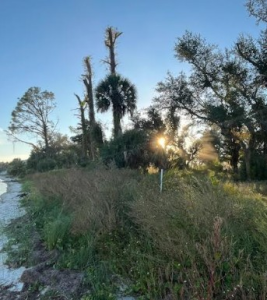
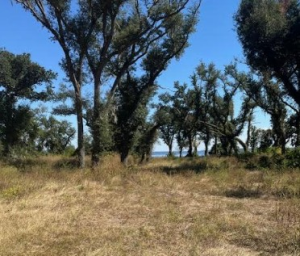
When my husband George and I bought a vacant two-acre waterfront lot in Parker, Florida, we dreamed of building a beer/wine garden to share with visitors and residents alike to enjoy the old oak trees and a tranquil view of the bay— instead we had to deal with a code enforcement complaint filed by the Mayor himself. What followed was a months-long paper trail of public records requests, verbal assurances, and a growing concern: Were we being selectively targeted while neighboring lots were overlooked?
This is the story of how I used Florida Sunshine Laws to uncover facts and speak up about being singled out.
Code Enforcement & Records Request Timeline
September–October 2022: The First Complaint and Cleanup
On September 20, a complaint about tall grass was filed against our property at 6021 E. Hwy 98. I later discovered it was submitted by the Mayor. The next day, the Code Enforcement Officer confirmed violations under Ordinance 26-101.2 and issued a notice.
We cut the grass on October 10. A few days later, on October 13, the Code Enforcement Officer told my husband, “you’re good.” No fines were issued, and no further action was requested. We thought the matter was resolved.
October 2022: Public Records Request
But I had questions. Why were we cited when other nearby lots were just as overgrown?
I filed a public records request to find out who filed the complaint and whether any violations had been issued for three other vacant lots nearby. Under Florida Statute 162.06(1)(b), code enforcement complaints can’t be anonymous — and that gave me the right to access the code violation complaint form.
When I received it, I was stunned: the Mayor had filed the complaint.
I also learned that no violations had been issued for the other vacant lots in the past two years. The city charged me $54 to fulfill the request.
After submitting the request, my husband, George, invited the Code Enforcement Officer to come out and confirm that the grass was being cut to their satisfaction. The officer called back and said he was too busy to come out — but told us we were “good.” At that point, we had only cut half the lot, so we stopped.
I honestly believe they didn’t want to enforce the rest because they knew I could prove selective enforcement by the Mayor of Parker.
December 2022: A Second Violation — and a Reactive Citation
Then, on December 29, we received a second violation — again for “untended growth.” This, despite the October cleanup and the officer’s verbal clearance.
But here’s the kicker: we weren’t even in Parker. We were visiting family in Ohio for the holidays and had already purchased airline tickets. The violation notice gave us a deadline of January 3, 2023 to cut the grass.
I called the Code Enforcement Officer and explained we were out of town and couldn’t possibly get back in time. He told me it didn’t matter — it was a hard deadline.
“You MUST have the two acres cut by January 3,” he said.
If we didn’t meet it, the letter warned, we’d face a $100/day fine.
I was confused and alarmed. We had been told we were “good” back in October. Why was this suddenly urgent — in the middle of winter?
I called a city councilwoman to ask for help. She called me back and confirmed what I feared: the Mayor had filed the complaint again.
George and I are law-abiding citizens. We’ve never had issues like this in our suburban Georgia community. We took the notice seriously. But once we learned the Mayor had filed the second complaint, we couldn’t help but feel targeted.
In the same December 29 email, the Code Enforcement Officer claimed:
“I’ve issued code violations on other vacant lots, including the property next to you…”
But that citation only came after I had challenged the fairness of code enforcement back in October— which made it feel like a reactive move to cover their tracks.
What This Timeline Reveals
This experience raised serious questions for me about how code enforcement is applied — and whether it’s being used as a political tool.
- The initial complaint came from the Mayor, not a neutral party.
- No other nearby lots were cited until I asked for records.
- The Code Enforcement Officer gave us verbal clearance in October, then reopened enforcement in December.
- The adjacent property was only cited after I challenged the process.
- The second violation was issued during the holidays, with an inflexible deadline and steep fines — even though we were out of state.
Why I Think the Mayor Targeted Me
Maybe it wasn’t just about the grass.
Back in March 2022, I filed a public records request for the technical review of a major development order — the kind of document that should be distributed in advance of a Planning Commission meeting. But it wasn’t. How can residents weigh in on developments if the information isn’t provided ahead of time — or even handed out at the meeting where it’s being discussed?
Then in July 2022, I requested the Sports Park site plan, the bids, and the FEMA grant underwriting the cost of the park’s redesign. Once I got the plans, I spoke up at a City Council meeting and pointed out that the tennis courts didn’t meet the city’s required setback. I also flagged other problematic details — like how the engineering firm had placed the dog park where electric poles were located.
Or maybe it was when I started raising my hand and asking, “When are public comments allowed?”
What Came Next: A Drive Toward Accountability
Faced with a looming deadline, the threat of daily fines, and the revelation that the Mayor had filed a second complaint, George and I decided we couldn’t stay silent. We packed up and drove down to Parker, Florida to attend the January 3 City Council meeting — determined to confront the Mayor directly, ask for an extension, and call out what we saw as unfair and retaliatory behavior. We also wanted to understand: How does this code enforcement process actually work — and who is it really serving?
That’s where Part Two begins.
Have You Faced Something Similar? Let’s Talk.
- Have you ever felt singled out by code enforcement in your town?
- Were you ever told “you’re good” by an official—only to be cited later?
- Do you believe code enforcement is being used fairly where you live?
- Have you spoken up at a city meeting and noticed a change in how you’re treated afterward?
- Do you think public officials should be allowed to file code complaints against residents they disagree with?
Your voice matters. If any part of this story resonates with you—or if you’ve experienced something similar—please share your story in the comments or contact Sunshine Law Citizen directly.